חיפוש מתקדם
BIS


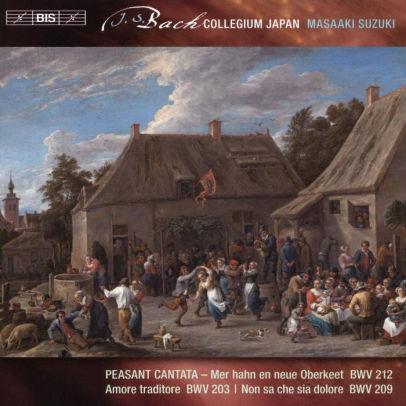
J.S. Bach: Secular Cantatas, Vol. 7 - Peasant Cantata

The so-called "Peasant Cantata, Mer hahn en neue Oberkeet, BWV 212," of Bach is a bit less often performed that his other major comic secular piece, the "Coffee Cantata, BWV 211." It's unlike anything else Bach ever wrote, with a text in Saxon dialect by Bach's frequent collaborator Picander poking fun at the region's new governor and painting various satirical genre scenes in the form of a dialogue commentary between two peasants. Bach responded with a unique tableau of little scenes that, with the exception of the soprano aria "Kleine-Zoscher müsse," consists of little bursts of music that put the emphasis on the text rather than conventional aria forms. The work is a unique product of Bach's old age, one with broad, and even raunchy, comic components that you might not think suited to the super-smooth talents of the Bach Collegium Japan and its conductor, Masaaki Suzuki, who are approaching the end of their magisterial Bach cantata cycle. But Suzuki strikes the right balance here, leaving the comedy to a pair of very well-chosen singers, soprano Mojca Erdmann and bass Dominik Wörner. Sample the 57-second "aria" "Fünfzig Taler bares Geld" (Fifty Dollars in Cash), for a taste of both the general style of the work and Wörner's ability to enter into its unique sense of humor. A pair of Italian-language arias, also fairly rare, and appropriate sound from Tokyo's Hajuku Hall round out a typically attractive entry in Suzuki's series.

Johann Sebastian Bach
Peasant cantata
CD


J.S. Bach: Secular Cantatas, Vol. 7 - Peasant Cantata

The so-called "Peasant Cantata, Mer hahn en neue Oberkeet, BWV 212," of Bach is a bit less often performed that his other major comic secular piece, the "Coffee Cantata, BWV 211." It's unlike anything else Bach ever wrote, with a text in Saxon dialect by Bach's frequent collaborator Picander poking fun at the region's new governor and painting various satirical genre scenes in the form of a dialogue commentary between two peasants. Bach responded with a unique tableau of little scenes that, with the exception of the soprano aria "Kleine-Zoscher müsse," consists of little bursts of music that put the emphasis on the text rather than conventional aria forms. The work is a unique product of Bach's old age, one with broad, and even raunchy, comic components that you might not think suited to the super-smooth talents of the Bach Collegium Japan and its conductor, Masaaki Suzuki, who are approaching the end of their magisterial Bach cantata cycle. But Suzuki strikes the right balance here, leaving the comedy to a pair of very well-chosen singers, soprano Mojca Erdmann and bass Dominik Wörner. Sample the 57-second "aria" "Fünfzig Taler bares Geld" (Fifty Dollars in Cash), for a taste of both the general style of the work and Wörner's ability to enter into its unique sense of humor. A pair of Italian-language arias, also fairly rare, and appropriate sound from Tokyo's Hajuku Hall round out a typically attractive entry in Suzuki's series.
CANTATA "WAHRLICH ICH SAGE EUCH" BW 86
CANTATA BW 51 "JAUCHZET GOTT IN ALLEN LANDEN"
CANTATA BW 147 "HERZ UND MUND UND TAT"
CANTATA BW 194 "HOCHESTERWUNSCHTES FREUDENFEST"
CANTATA BW 147 "HERZ UND MUND UND TAT UND LEBEN"
CANTATA "WAS MEIN GOTT WILL" BW 111
CANTATA BW 42 " AM ABEND ABER DESSELBIGEN SABBATS"
CANTATA BW 180 'SCHMUCKE DICH
CANTATA BW 147 "HERZ UND MUND UND TAT"
CANTATA BW 12 "WEINEN KLAGEN SORGEN ZAGEN"
CHRISTMAS CANTATAS
CANTATA "JESU NUN SEI GEPREISET" BW 41
CANTATA BWV 4"CHRIST LAG IN TODESBADEN"
MUSICAMERA /MUSIC IN OUR TIME /THE AGE OF ECSTASY
CANTATA BW 76 "DIE HIMMEL ERZAHLEN DIE EHRE GOTTES"
Johann Sebastian Bach
After Bach
BACH, JOHANN SEBASTIAN