חיפוש מתקדם
DG

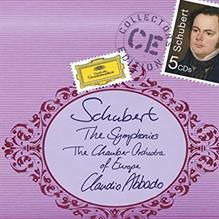
Sets of Franz Schubert's complete symphonies fall into two categories, either presenting the Symphonies, Nos. 1-6; the two movements of the Symphony No. 8, "Unfinished"; and the Symphony No. 9, "Great," with or without miscellaneous filler pieces, or, more innovatively, offering all of the above, a reconstruction of the sketches for the Symphony No. 7, and a completion of the last two movements of the "Unfinished." While the latter would be best represented by Neville Marriner's fascinating box set on Philips, which includes even sketches for unnumbered symphonies and a Symphony No. 10, most sets follow the first and simpler layout, without any speculation over what Schubert might have written, and focus instead on the masterworks that are beyond any dispute. Claudio Abbado's set for Deutsche Grammophon basically belongs in the first category, because none of the sketches are bothered with. However, along with its unsurprising choice of the Rosamunde Overture as filler, the orchestrated "Grand Duo" Sonata in C major makes a rare appearance. This work was originally composed for piano duet, but the famous violinist Joseph Joachim arranged it in 1855, and it is the best-known orchestral treatment of this large-scale keyboard work. It has features common to Schubert's symphonic style of his last years and is fairly convincing for its resemblances in lyrical flow to the "Unfinished" and in its expansive framework to the "Great." Abbado's performances with the Chamber Orchestra of Europe are first-rate readings that have fresh touches that keep the listener alert for novelty, and the orchestra plays with spontaneity and warmth. Deutsche Grammophon's reproduction is exceptional, as always.


SCHUBERT, FRANZ
THE SYMPHONIES

Sets of Franz Schubert's complete symphonies fall into two categories, either presenting the Symphonies, Nos. 1-6; the two movements of the Symphony No. 8, "Unfinished"; and the Symphony No. 9, "Great," with or without miscellaneous filler pieces, or, more innovatively, offering all of the above, a reconstruction of the sketches for the Symphony No. 7, and a completion of the last two movements of the "Unfinished." While the latter would be best represented by Neville Marriner's fascinating box set on Philips, which includes even sketches for unnumbered symphonies and a Symphony No. 10, most sets follow the first and simpler layout, without any speculation over what Schubert might have written, and focus instead on the masterworks that are beyond any dispute. Claudio Abbado's set for Deutsche Grammophon basically belongs in the first category, because none of the sketches are bothered with. However, along with its unsurprising choice of the Rosamunde Overture as filler, the orchestrated "Grand Duo" Sonata in C major makes a rare appearance. This work was originally composed for piano duet, but the famous violinist Joseph Joachim arranged it in 1855, and it is the best-known orchestral treatment of this large-scale keyboard work. It has features common to Schubert's symphonic style of his last years and is fairly convincing for its resemblances in lyrical flow to the "Unfinished" and in its expansive framework to the "Great." Abbado's performances with the Chamber Orchestra of Europe are first-rate readings that have fresh touches that keep the listener alert for novelty, and the orchestra plays with spontaneity and warmth. Deutsche Grammophon's reproduction is exceptional, as always.
THE COMPLETE SYMPHONIES
SYMPHONY No 2 IN B FLAT MAJOR D 125
SYMPHONY No 7 IN A MAJOR OP.92
SYMPHONY No 3 IN D MAJOR D 200
SYMPHONY No 6 IN F MAJOR OP.68 "PASTORALE"
SYMPHONY IN D MAJOR OP.3 No 2 /SYMPHONY IN E FLATMAJOR OP.11 No 3 / 3 "MANNHEIM" SYMPHONIES
SYMPHONY No 1 IN D MAJOR D 82
4 SYMPHONIES FOR STRINGS Wq.183
THE LAST SIX SYMPHONIES VOL.3
THE COMPLETE SYMPHONIES
THE SYMPHONIES
COMPLETE SYMPHONIES
CHAMBER SYMPHONIES Nos.1-5
PETER & THE WOLF
SYMPHONIES 40 & 41
SYMPHONY No 9 IN C MAJOR D 944 "THE GREAT"
Beethoven Symphonies 1-9
SCHUMANN, ROBERT (1810-1856)
BEETHOVEN, LUDWIG VAN