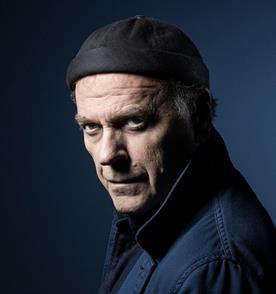

Born in Yugoslavia, his mother was Czech and his Bosnian father used to be Tito's tailor. His family fled the country to France in 1960, where Enki learns French and discovers cinema and comic books. In 1971, he wins a contest organized by the famous comics magazine Pilote with his first story "L'appel des étoiles". It's published in Pilote and later re-released under the title "Le bol maudit", and it allows Enki Bilal to start working for the magazine by drawing politicians.
Bilal gained international fame with his Nikopol Trilogy: The Carnival of Immortals (1980), The Woman Trap (1986), and Cold Equator (1992). This visionary saga—merging political themes, Egyptian mythology, and cyberpunk aesthetics—was praised for its rich narrative and singular visual style.
In the 2000s, he continued his exploration of the world's dysfunctions with The Monster Tetralogy (1998–2007), centered on Nike Hatzfeld, a survivor of the Balkan wars, and the Coup de Sang Trilogy (Animal'z, Julia & Roem, The Color of Air), which addressed climate issues and human transformation.
Alongside his work in comics, Bilal directed several films, including Bunker Palace Hôtel (1989), Tykho Moon (1996), and Immortel (ad vitam) (2004), a loose adaptation of his Nikopol Trilogy. He also collaborated with Alain Resnais on Life Is a Bed of Roses (1983), designing its sets and costumes.
Bilal is one of the few comic artists to have exhibited at the Louvre, with The Ghosts of the Louvre (2012–2013), a series of paintings layered over photographs of museum masterpieces. He has also shown his work at the Musée des Arts et Métiers (Mécanhumanimal, 2013), the Musée de l'Homme (Carte Blanche, 2022), and the Giorgio Cini Foundation in Venice (Inbox, 2015).
Among his honors are the Grand Prix of the Angoulême Festival (1987), the Adamson Award in Sweden (1999), and the title of Chevalier of the Legion of Honor (2010). In 2019, he served on the Cannes Film Festival jury.
Enki Bilal continues to probe the boundaries between imagination and reality, addressing technological change, political drift, and ecological crises through a body of work that is dense, visionary, and profoundly humanist.