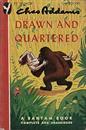
Prior to this 1942 volume, Steig was mostly known for humorous cartoons about city children published in "The New Yorker." 1939's "About People" started him on the course toward "symbolic drawings." This one, though, took a new, determined direction towards abstraction in the service of truth telling and examining the psyche of man.
On the left page, opposite each drawing, is a caption, or, more accurately, a statement. This statement is coming from the mind, or the mouth, of the character we see to the right. He, or she, is the subject of some disease of the mind that keeps them outside the realm of normal, conformist, well-adjusted, lock-in-step society. They are the Lonely Ones.